AddThis

AddThis Smart Layers

Showing posts with label ww2. Show all posts

The Atkins Siblings and the Guards Chapel Tragedy: Remembering the Largest V1 Bombing Loss of Life, 18th June 1944

Amy Atkins, born 17 April 1871 Woman Clark-Board of Education aged 73 

Philip Atkins 17 Feb 1874. Retired Bank Clark, Bank of England, aged 70


Both the Atkins, brother and sister, died on the 18th June 1944, in the bombing of the Royal Military Chapel Wellington Barracks. Known as the Guards Chapel. Bird Cage Walk, just a few minutes from Buckingham Palace. 

The worst loss of life cause by a V1

The Sunday morning service was packed with guardsman, their families and friends. when disaster struck. At 11.11 am, the congregation were about to sing the Te Deum. When the noise of a V1 was heard, (the sound of a cheap outboard motor, an old model Ford) the engine cut out, followed by a brief silence, an intensive blue flash and an explosion. The chapel was hit when the flying bomb nosedived on to the chapel roof, entered through the western end and exploded, destroying the roof, its supporting walls, concrete pillars and the portico of the western door. The congregation were buried in 10ft of rubble. 

The death toll was124, 65 Military and 59 Civilians, (one unknown woman, buried in Westminster Cemetery) and well over a 100 injured, many seriously. The chapel was completely destroyed with the exception of the apse. The Bishop of Maidstone (Leslie Owen), who standing at the Alter was one of the very few left uninjured but he was very shaken by the explosion. 

The rescue crews and first aid teams, found a scene of utter devastation with an assessment of 400-to 500 casualties. The debris appeared impenetrable, the collapsed roof and walls had left many trapped, with doctors and nurses obliged to scramble between the concrete walls to administer morphine and first aid. Several rescuers and survivors recalled that the silver alter cross had been untouched by the blast and continued to burn. (the same cross and candle sticks remain in regular use today)

Coordinated by the rescue services and guardsman from the barracks, the rescue effort went on, day and night, for 48 hours before the last body was removed.  The incident was not declared closed until just before midnight on Wednesday, 21 June, 84 hours after the explosion. It was the largest loss of life through a V1 attack


The destruction of the Chapel was the largest single incident caused by the V1 Rockets.


You can visit the guards chapel today, which was rebuilt in the 1960's. The portico which sheltered the Bishop of Maidstone survived and forms part of the new structure.

Dates of Note; at the time

D Day the 6th June 

Cassino, a month earlier

First Doodle Bug to hit London. 13th June 1944 fell in Bow. East London.

18th June 1915. Anniversary of the Battle of Waterloo (Guards battle honour)


Dundee Courier 26 December 1945


Despite wartime restrictions, a temporary chapel was erected in a Romney Hut attached to the undamaged apse and this was used from Christmas Day 1945 until 1962 when the rebuilding began.


Burial entry, the cremated remains 


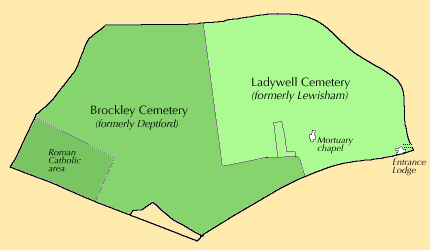
The Funeral of Philip and Amy was held at St John the Baptist, Holland Road, a few doors from their home, on Monday, 26th June 1944, followed by cremation at Golders Green. Their ashes were later buried in Ladywell Cemetery, in the grave of their sisters Dora, Mabel and Kate.

Ladywell Cemetery. Plot No. D.125a

The grave of their parents Charles and Caroline, lies just to the front of the grave.

-------------

Put together By Phill Barnes-Warden. FoBLC Committee Member.

Research from the book by Jan Gore. Send More Shrouds: The V1 Attack on the Guards' Chapel 1944.Pen & Sword Books. 

Also the websites

https://www.householddivision.org.uk/guards-chapel-about

https://theguardsdepot.co.uk/guards-chapel-v1-flying-bomb-wellington-barracks-1944/


Brockley's most important contribution to the D-Day landings

The most important local contribution to the invasion of Europe was made indirectly by William Potter Stone & Co., plumbers of Malpas Road. Frank Stone (1913-2004), a partner in the firm and the son of the founder, was born in Brockley, and was an old boy of Mantle Road School and Addey and Stanhope. He had become the leading expert on the welding of lead pipes, and in 1942 was called in by Siemens of Woolwich to advise on the design of Pluto (Pipe Line Under The Ocean), which supplied the Allied armies with fuel for tanks, planes, and trucks. Frank and his brothers personally welded together all the sections of the twenty-one pipelines laid under the Channel. At its peak Pluto was delivering one million gallons of fuel a day to the front line.


Located close to the pathway adjoining Brockley road lies the recently restored family grave of the Stone family. Frank Stone, was one of the unsung heroes of the civilian effort in the Second World War; a leadburner by trade, his skill and ingenuity made possible the construction of "Pluto" - the Pipeline Under the Ocean - which supplied fuel to the Allied forces after D-Day.

The establishment of a reliable source of petrol for the period following the D-Day landings was a high priority for the military planners. Any loss of momentum caused by problems in fuel supply could have jeopardised the whole operation, giving German forces the opportunity to re-group and counter-attack. Conventional tankers and ship-to-shore pipelines would be vulnerable to the Luftwaffe, and it was Lord Mountbatten, Chief of Combined Operations, who suggested an undersea pipeline. At first this seemed an impossible proposal: no pipeline had yet been built that could be relied upon to be flexible in rough seas and stand up to the pressure under water.

If a pipeline failed, it would have been impossible to carry out repairs. Yet, in 1942, Siemens Brothers of Woolwich were commissioned to design a suitable pipeline. It was a complex task, and there were many failures at the design stage arising from kinks, bursts and collapses due to external water pressure and other forces; the joints between pipe sections were particularly vulnerable.
In 1942 Frank Stone and his brother Albert, then working in the family lead specialist business, W P Stone, were called upon by Siemens and asked to develop a method of jointing 700-yard lengths of extruded lead alloy pipes, capable of being fully flexible, as strong or stronger than the lead pipe itself, able to withstand coiling, and capable of passing over special wheels in order to be covered in steel pressure tapes and steel armour wires.

The two brothers set to work, producing sample joints for test purposes, and, after a short period of intense effort using various lead alloys, a joint was produced which passed all the bending and pressure tests. The Stones were duly awarded the contract to make the joints for a five-mile length of armoured pipeline for laying trials in the River Thames. The final specification for the pipeline was for a flexible tube comprising an inner lead pipe 3 in in diameter, encased in layers of tape, bitumen and steel and wire. As Siemens did not have enough capacity at their works in Woolwich, Callenders Cables of Erith were co-opted to increase the overall output.

For about two years, Frank Stone and his brothers, Albert and Ron, worked at Woolwich and Erith, making more than 500 joints at Siemens and more than 800 at Callenders. They worked 18-20 hour shifts, seven days a week, leadburning nearly all the joints that eventually made up the 11 pipelines laid between Dungeness and Boulogne (each of 32 nautical miles), and the two pipelines laid between Shanklin and Cherbourg, each of 70 nautical miles. The pipelines were ready by D-Day, but were not laid until after the French coastal area had been cleared of the enemy. The millions of gallons of fuel they supplied helped to ensure that the Allied armies could break out after D-Day. General Eisenhower described the Pluto project as "second in daring only to the artificial 'Mulberry' Harbours".

The Stones' work was so secret that they could not even tell their father - had the secret leaked, the cable works would have become prime targets for enemy aircraft. The secrecy also meant that the Stones' efforts went largely unrecognised; but the pipeline never failed in its operational life.

PLUTO, the WW2 Pipeline Under the Ocean, was designed to supply petrol from storage tanks in southern England to the advancing Allied armies in France in the months following D-Day.

In a very short time a continuous flow of fuel was up and running. It is estimated that between August 1944 and May 1945 PLUTO delivered over 172 million gallons to France. As the Allies moved inland, the pipeline was transferred from the Isle of Wight to Dungeness in Kent to shorten the supply route. PLUTO was the world’s first undersea oil pipeline and made a major contribution, not only to the Allied war effort, but also to subsequent pipeline development.

Pluto (Pipe Line Under The Ocean), which supplied the Allied armies with fuel for tanks, planes, and trucks.

The second of seven children, Frank William Stone was born at Brockley, south-east London, on November 19 1913. His father, William Stone, had founded the family ship and chemical plumbing business, W P Stone, in 1896. The firm became one of the first specialist leadburners in London.
Frank was educated at Addey and Stanhope Grammar School, Deptford, where he won prizes for art, then joined the family business as an apprentice in 1929, becoming a director in 1933.
At the outbreak of war, as members of a reserved occupation, Frank and his brothers were exempted from military service. Albert joined the Home Guard, and Frank and Ronald served as fire watchers. In addition to their work on Pluto, they manufactured hundreds of lead-lined tanks for the chemical and electroplating industries, carrying out maintenance site-work in chemical plants.
After the war, Frank became managing director of the family business, which remained involved in undersea cable work and, during the 1950s, went into making lead radiation protection equipment for hospital radiotherapy departments.

In 1957 Stone joined James Girdler, another lead specialist firm, based at Acton, as managing director. He built up the business, taking advantage of the increased demand for lead shielding in the nuclear industry and in specialist cancer hospitals. He also became involved in the production of diagnostic and therapeutic "phantoms" - simulacra of human bodies with real human skeletons inside. These were designed to avoid the use of human volunteers during the calibration of X-ray and radiation therapy machines.

Stone retired from James Girdler in 1978, though he remained a consultant to the firm for a further three years and continued to work as a freelance consultant to the cable industry until the age of 83. In 1987 he returned to Erith to leadburn nine joints for a high voltage supertension submarine cable to be laid across the Madura Straits, from Surabaya to Madura Island, Java, in Indonesia.
Frank Stone married, in 1939, Margaret Cassidy, converting to Roman Catholicism on his marriage. After the war, he joined the Knights of St Columba and was actively involved in homelessness projects in the capital. In 1967 he was awarded the papal medal Pro Ecclesia et Pontifice by Pope Paul VI for services to the Roman Catholic Church. In 1999 he was awarded the Inaugural Lifetime Achievement Award by the Lead Sheet Association.

Stone family grave near Brockley Road with a new headstone which recognises Frank’s contribution to the D-Day landings


(Source : Daily Telegraph Obituary 2004)

Commonwealth War Graves Tour

Commonwealth War Graves Tour 22/11/15 2pm to 3:30pm, meet Ladywell Chapel
Our next guided walk will concentrate on the Commonwealth War Graves Commission memorials in Brockley & Ladywell Cemeteries as part of their Living Memory Project. .  We are also intending to have a small relevant display of photos and other information in the Ladywell Chapel from 1:30pm to 3:30pm.

The walk will start at 2pm on Sunday 22nd November and we'll meet at the Chapel.   Please come along, and encourage your friends and neighbours to join us