AddThis

AddThis Smart Layers

Showing posts with label war poet. Show all posts

Borders in the Literary and Visual Arts of David Jones

The modernist poet  David Jones, whose work was greatly admired by T.S. Eliot and W.S. Auden, and who lies buried in the Brockley & Ladywell Cemeteries is to be featured in a seminar by The David Jones Society in the Dissenter's Chapel on Saturday 22nd September. 

You can read Mike Guilfoyle's account of his life here and see below for an interview that Anne Price-Owen of the David Jones Society gave to the BBC.


The event costs £10 and all are welcome to attend.  The programme of events is listed below:


The David Jones Society Ladywell Seminar: 22nd September 2012

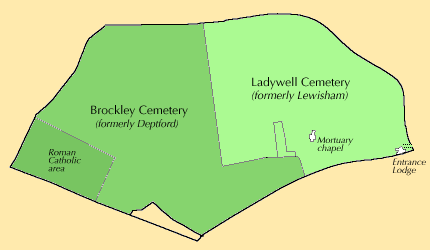
Ladywell Dissenter’s Chapel, Brockley & Ladywell Cemetery

Borders in the Literary and Visual Arts of David Jones


10.00am Registration & Coffee

10.30am Mike Guilfoyle: Introduction to Ladywell & FOBLC and a brief guided tour around Ladywell Cemetery

11.15am Anne Price-Owen: Brief introduction on the Seminar Speakers

11.30am Sir Steve Bulloch, Mayor of Lewisham welcomes the David Jones Society toLewisham

11.50am Prof William Blissett: ‘David Jones After Seventy Years’

12.30pm Jasmine Hunter Evans: ‘David Jones & Cultural Borders: “To all the natives ofthe whole white (shining, beautiful) Island of the people of the Britons”’

1.00pm – 2.30pm; LUNCH: make your own arrangements locally

2.30pm A.C.Everatt: ‘Footnotes to a Wounded Man’

3.00pm Esther de Waal: ‘Living on the Border: Reflections on the Experience of Threshold’

3.30pm Anne Price-Owen: ‘The Differentiated Sites’

3.50pm Sheila Beskine: ‘The Significance of Borders in the Arts of David Jones’

4.15pm Tea & close of seminar

 
Before the cemetery officially closes at 5.00pm, there should be time for visitors totake a final wander around the graveyard.

6.30pm Dinner at  Ladywell Tavern for those who have pre-booked.

Tome of the unknown soldier


The World War 1 poet David Jones, who lies buried in the Brockley & Ladywell Cemeteries, is the subject of an article in the New Statesman by David Wheatley.

To read more click here

In responsse FOBLC member and literary expect Mike Guilfoyle has written the following letter to the New Statesman commenting on this article. You can also read the piece he previously wrote for us on David Jones here

Poet's corner
I thoroughly enjoyed reading David Wheatley's piquant piece on the neglected poet-painter David Jones (The Critics, 16 August). Jones is buried in Ladywell Cemetery in south-east London with his parents and sister. In November, to commemorate Armistice Day, we hope to hold an event in the cemetery, including poetry readings and musical recitals, so that the wider public might have the chance to hear extracts from his Great War masterpiece “In Parenthesis".
Mike Guilfoyle
Friends of Brockley and Ladywell Cemetery
Via email

David Jones: war poet and genius: by Mike Guilfoyle

It is humbling to think that this 'modern genius' at once painter, poet, essayist, and engraver' lies almost unknown in the Brockley & Ladywell Cemeteries(close to the graves of Ernest Dowson & Fernando Del Marmol) even though David Jones is critically acclaimed as one of the five greatest modern writers along with Eliot, Joyce, Woolf and Becket.


David Jones (1895-1974) was born & raised in Howson road in Brockley. At the age of fourteen, he began studying at the Camberwell School of Arts & Crafts(1909-1914) and after being demobilised at the Westminster school of Art. In January 1915 he enlisted as a private in the newly formed 15th London Welsh battalion of the 23rd Foot, Royal Welsh Fusiliers and served at the front until March 1918. He was injured during an attack on Mametz Wood(10-11th July 1916) and subsequently saw action on the Ypres salient at Passchendaele. Suffering from trench foot he was evacuated and spent the rest of the war in Ireland.

He entered the Catholic church in 1921 and became close friends with the sculptor, Eric Gill, exhibiting with the Seven & Five Society. In 1932 he suffered the first of two nervous breakdowns caused partly by his war experience. On reading , All Quiet on the Western Front' he was heard to say, 'Bugger it, I can do better than that' and in 1937 his first epic poem. 'In Parenthesis' (with an introduction by T.S.Eliot) based on his experiences as a private infantryman in the trenches was published. It was celebrated as one of the masterpieces of modern literature, by amongst others W. B. Yates. Described by Thomas Dilworth( David Jones Scholar) as the ' greatest literary work in English on war.'

(http://www.elizabethhaines.co.uk/somme.htm)

He later wrote another epic length work, The Anathemata(1952) which W.H. Auden regarded as probably the best long poem in English of the twentieth century. Jones resumed painting and enjoyed a long friendship with the Art Historian, Kenneth Clark, who referred to Jones as 'a remarkable genius'.

He lived for the rest of his life in Harrow , producing lettered inscriptions and collections of more accessible essays on art and culture. He died in 1974 and is buried with his parents in the cemetery. A memorial stone by the celebrated sculptor John Skleton was unveiled in 1975 on the grave. In 1985 David Jones was among sixteen Great war Poets commemorated on a slate stone at Westminster Abbey. He deserves wider recognition(locally and nationally) and readers who are interested can find out more information about his life & works from among other sources that of the David Jones Society