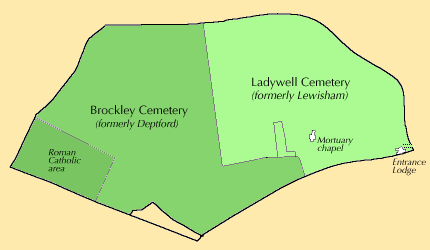
I thought that I would depart from my usual pattern of offering historical vignettes of some of the illustrious deceased buried in the two cemeteries and instead present the reader with some of my more memorable personal recollections, out of many, that have charted my time as a member of the Friends group and former Chair. By limning and selecting six discrete memories, drawn from the Foblc website (wonderfully edited by Patrick Napier) I hope to share something of my enduring taphophile passion for the historical richness which the cemeteries offer. But also a helpful timeline of my involvement with the Friends group for whom I owe an immeasurable debt of gratitude and dedicate this valedictory post to my colleagues who have shared in this journey.
I have opted to copy into these posts some of the commentary originally offered for ease of convenience and to recognise that my parlous state of health needs some respite, but also for offering a lens into the freshness of the event, rather than a vapid recitation of moments in time sieved from the cemetery back locker
The first of these lasting memories dates from 2010 with the restoration of the grave of the 19th century poet, Ernest Dowson.
Ernest Dowson Headstone restored

On Monday 2nd August there was a short ceremony at Brockley and Ladywell Cemetery to mark the restoration of Ernest Christopher Dowson's grave on the 143rd anniversary of his birth. The original memorial has been restored as fully as possible and a new stone at the foot of the grave quotes two verses of his poetry from Vitae Summa Brevis. 'They are not long, the days of wine & roses'.
The restoration was paid for by public subscription after a Facebook page was set up in his memory by Philip Walker. Attendees were an eclectic mix of local authors, poets and historians. Father Michael Lovett ( St Mary Magdalen's, Brockley) conducted a Service in the Dissenters Chapel after author Jad Adams (Dowson's Biographer) spoke movingly to the seventy or so present about Dowson's legacy at the graveside. He had earlier spoken on the Radio 4 Today programme together with local poet Katy Evans-Bush.
The music of Delius (to words by Dowson) wafted into the Chapel. Following the service many of those in attendance decamped to the Brockley Jack for an informal reception. Foblc's Mike Guilfoyle regaled those present with Dowson's poem 'Dregs' suitably delivered! Several of those who had made the effort to be present came from overseas (including a family from Italy whose aim is to see Dowson translated into Italian). Also present was an admirable representative of the Aubrey Beardsley Society who had travelled from Brighton dressed in contemporary funeral garb and dispensed shortbread with a Dowsonian brio! The absinthe tipple did attract one or two of the hardier visitors.
Hear the Radio 4 Dowson remembrance - Was this the first time the Brockley & Ladywell Cemeteries have ever been on national radio?

First to the Corinthians: the story of England goalie Harry Albemarle Swepstone
Having a framed copy of a South London Press article on one's wall at home might not engender a flurry of wonderment. But discovering the grave of an England goalkeeper might tilt the balance is my second shared memory:
.png) |
Harry Albemarle Swepstone (1859-1907) who was born in Stepney, East London, made his England debut against Scotland in 1880. During this match he was beaten by a 'cannon shot' from the Scottish 'Rooney', Centre Forward George Kerr. Harry had the dubious distinction of conceding 18 goals in six international matches as England goalkeeper between 1880 to 1883. When the famous Corinthian amateur football club was formed in 1882 to improve the flagging fortunes of the England football Team (sound familiar?!) and challenge the then supremacy of the Scottish Football Team, he suggested the name, which was accepted unanimously. The football club later came to be known as the Corinthian-Casuals in 1939, and was based in Tolworth after moving from Crystal Palace.
The world famous Brazilian Corinthian Paulista club founded in 1910 was inspired to adopt the name, following an historic football tour undertaken by the London based club. Real Madrid adopted the Corinthian's white shirts for their iconic strip. The team now play in the Isthmian League Division One South. Harry also played for Pilgrims FC and was an FA Cup winner in 1879/80. A solicitor by profession he practised at Bishopsgate and served on the FA committee in 1883/84. Harry died on the 7th May 1907 and is buried with his wife, Emmie and daughter who pre-deceased him aged just 10 years old. The family grave(which is sadly neglected) lies a few yards from that of the newly restored grave of the poet Ernest Dowson in the Ladywell section of the cemetery.
War poet David Jones commemorated with maroon plaque
Achieving the ambition of securing a maroon plaque for the poet, artist and soldier was one of those momentous occasions when my pride and joy in this collective act of remembrance brought home to me the strength of feeling attached to being a member of the Friends group. It is the third of my six memories.

The campaign to recognise David Jones, Brockley's most illustrious poet, soldier, artist has been spearheaded by the Friends of Brockley and Ladywell Cemeteries and all the funding to pay for the maroon plaque was sourced from the generous donations of admirers of David Jones with the support of the Homeowners and Lewisham Archives. The maroon plaque celebrates the achievements of former residents of Lewisham Borough.The unveiling was undertaken by Nicholas Elkin, trustee of the David Jones Society and great nephew of the war poet.
.jpg "Thomas Dilworth David Jones biography")
One worthy quote from the book 'I would like to have done anything as good as David Jones has done’ Dylan Thomas
On the 2nd December at 67 Arabin Road, SE4 there was an unveiling of a maroon plaque to commemorate the Great War poet, soldier and artist David Jones (1895-1974), who is buried in Ladywell Cemetery. Born in Brockley in 1895 he served in the Royal Welsh Fusiliers during the Great War, having interrupted his studies at Camberwell Art School, and was wounded at the Battle of Mametz Wood during the Somme Offensive in July 1916. Of all the Great War poets he served the longest on the Western Front and his superb poetic memoir 'In Parenthesis' published in 1937 won the prestigious literary award The Hawthornden Prize and was described by writer T.S. Eliot as a 'work of genius'. A convert to Catholicism, he spent time with the sculptor and artist Eric Gill and his calligraphy and brilliant artistic outpourings were compared by the art historian Kenneth Clark to those of the artist William Blake. He suffered greatly from the trauma of the trenches which resulted in nervous breakdowns and much of his artistic imagery is defined by these formative experiences. Following the publication of his second long poem 'The Anathemata' in 1952 his critical acclaim as a poet and artist merited the accolade from Poet WH Auden as' probably the finest long poem written in English this century'. David Jones died in Harrow in 1974 and was buried in the family grave in Ladywell cemetery. On November 11th 1985 the Poet Laureate Ted Hughes unveiled a memorial stone in Poets Corner Westminster Abbey to sixteen Great War poets including David Jones.
Kent and England cricketer Edgar 'Ned' Willsher
Serendipity and cemetery research seem at times to be kindly aligned, Certainly with the fourth inclusion this was very much the case.

For some years now one of the unrealised ambitions of the more active headstone hunters of the friends group, has been to locate the final resting place of the Kent and England cricketer Edgar 'Ned ' Willsher (1828-1885) who was the catalyst for the shift from round arm to overarm bowling. That ambition was finally realised recently when working with a black and white photograph of the stump of the Willsher headstone in Ladywell cemetery (featured in Giles Phillips 2012 biography on Edgar Willsher, 'The Lion of Kent') three members of the friends group experienced that jubilant eureka moment, having lighted on the remnants of the family grave close to one of the inner pathways nor far from the Ladywell chapel.
Born in Rolvenden, Kent in 1828 into a family with cricketing associations , Edgar whose fast left -handed bowling was to be his trademark, made his debut for Kent in 1850 at the Kennington Oval against Surrey. By 1860 his impressive wicket tally meant that he was now established as the key bowler for Kent,including securing a career best innings figure of 8/16 as well as scoring a maiden half-century with the bat.
Although by the 1860's round arm had replaced had replaced underarm as the standard method of bowling, overarm was still illegal.But in August, 1862 at the Oval, Edgar became the first cricketer to be no balled for bowling overarm. Playing for an England X1 against Surrey he was called no less than six times by the umpire , John Lillywhite ( of the famed sports outfitters family) for delivering the ball with his hand above his shoulder. Edgar then left the field with eight of his team mates and the game was then abandoned for the rest of the day. When the game was resumed (with Lillywhite being replaced as umpire ) he recorded 6 wickets for 49. As a result of the game, cricketing law was changed and from the beginning of the 1864 season, overarm bowling was legalised.
Edgar played first class cricket for Kent from 1850 to 1875 and took over 1,300 first class wickets ( in spite of having only one lung!) He led a tour of Canada and the USA in 1868 ( which included games of baseball ) and after retiring from cricket he became an umpire. Edgar played alongside the legendary W G Grace in his final invitation game.
The renowned bowler , known as the 'Lion of Kent' died in Lewisham in 1885, now forever famed in the annals of cricketing history for his bold move in walking off the field in 1862 to draw attention to the growing clamour to introduce overarm bowling.

Author with cemetery luminary Mick Martin(green top)
Passchendaele - Second Lieutenant Hugh Gordon Langton
The penultimate post has its own special poignancy as it involved members of the friends group visiting the town of Ypres, Belgium in 2017 to mark the centenary of the Battle of Passchendaele. The story is told here:

One of many iconic images of the Passchendaele battlefield in 1917.-
Passchendaele is a small village five miles north-east of Ypres (Belgium) and is the name by which the final stages of the Third Battle of Ypres is better known. Along with the Somme, it has come to symbolise the Great War for many. The Third battle of Ypres was preceded by the attack on Messines ridge in June 1917. The main battle commenced on the 31st of July 1917, and stretched on until November the 10th, 1917. The final phase, the advance on Passchendaele, took place in October and November, the aim being to take the strategically important high ground of the Passchendaele ridge. The first battle of Passchendaele, on the 12th October, failed to take the village, and the second battle of Passchendaele lasted from the 26th of October until the 10th of November. After over three months, with 325,000 Allied and 260,000 German casualties the result was little more than to expand the ground covered by the Ypres salient and the controversy over the conduct of the Battle remains to this day.


Headstone of Second Lieutenant Hugh Gordon Langton -Poelcapelle British cemetery, West Flanders Belgium
On Sunday, November 5th, 2017 at Poelcapelle CWGC Cemetery nr Ypres , Belgium, there was a ‘special centennial memorial’ for Second Lieutenant Hugh Gordon Langton, (4th Battalion-London Regiment) Royal Fusiliers, who was killed in action on October 26th, 1917, during the ‘Battle of Passchendale’. - Eight members of the Friends group attended as part of a British delegation at the kind invitation of Gil Bossuyt ( Local First World War guide). Also in attendance playing the moving music for the tribute were 45 musicians of the local Flemish Deerlijk Brass Band The event was recorded by the Commonwealth War Graves Commission ( see link below) and in a welcome break in the weather during a sunlit interlude a poppy wreath was laid at the headstone.
Hugh Gordon Langton was a very promising violinist, who was taught by the most prominent music teachers from that time from across Europe. The grave of Hugh Gordon Langton is the only one of all Commonwealth graves and memorials (there are more than a million worldwide) which has musical notes inscribed as an epitaph. However a recent tonal revision of the musical notation -the piece was originally thought to have been from ' After the Ball is over' a popular Tin Pan Alley song from 1891 has led to some doubts by music scholars as the notes would suggest a different composition?
As part of the planned visit the Friends group were able to benefit from an excellent guided walk from Gil over parts of the former Battlefield , to be present at the playing of the last post at the Menin gate, Ypres and to enjoy the warm hospitality offered after the Sunday tribute by sharing in a memorable meal with Gil and members of the band in nearby Zonnebeke before returning home.

The family grave lies in Brockley cemetery.
Jane Clouson book launch
The final memory dates to a book launch in the Chapel at Ladywell cemetery in 2016.
Jane Clouson's tragic story and that of the controversial criminal trial of the man accused of her murder was vividly recounted at the launch in the critically acclaimed book Pretty Jane and the Viper of Kidbrooke Lane by US author and academic Paul Thomas Murphy, nominated for an Edgar award for best crime Non-fiction in 2017. He had travelled from his home in Colorado(USA) to present his findings and the enraptured audience greatly appreciated his presentation after four years of research.
An article in the South London press in 2021 by Mike can be viewed here : https://londonnewsonline.co.uk/jane-was-16-pregnant-and-brutally-murdered/
Paul Murphy's latest book is on the 19c polymath John Ruskin who was a close friend of Sir John and Lady Simon they are buried in Ladywell cemetery.

The brutal murder of Jane Clouson in Eltham, South London in 1871 became a press sensation, with the police investigation and the trial keeping the public gripped with the accused's acquittal (largely due to legal rulings disallowing key evidence) causing outrage. This overdue re-examination of the case and the subsequent libel trials fought by the prime suspect reviews the evidence in the light of 21st-century procedure and finally identifies the culprit of this long-unsolved killing!
I hope this ready made assemblage of highlighted memories offers the reader some added interest in returning to past posts that have galvanised and enthralled me over the years I have been a member of the Friends of Brockley & Ladywell cemeteries.
Readers can also uncover some of the many other luminaries buried here by accessing my four history guides and twelve narrated podcasts (the latter free to download) flagged up on the sidebar of the Friends group website: https://www.foblc.org.uk/
Mention should also be made of the welcome publication of the latest edition of Hugh Meller and Brian Parsons Illustrated Guide and Gazetteer to London Cemeteries (including an expanded section on Brockley & Ladywell cemeteries) and now available to buy from stockists.


