AddThis

AddThis Smart Layers

Showing posts with label First World War. Show all posts

Gertrude Anna Middleton O.B.E - The Recent Discovery of a Heroine of the Great War in Ladywell Cemetery

Gertrude Anna Middleton O.B.E.

Or Gertie as she is known on her headstone.


A grave that has been passed by many over the years without giving a second glance. For what you see from the pathway is her mother Emma, look to the other side and you will find Gertie with her father Henry Milnes Glover.

Anna Glover was born in Liscard, Cheshire on the 23rd July 1889, her parents Henry Milnes Glover and Martha Maria Emma Hedwig Glover, the 1911 census shows Gertie at the age of 23 a school mistress living at 102 Embleton Road Ladywell, living with both of her parents and two older sisters.

In October 1916 at St Saviours Paddington, Gertrude married Albert Henry Middleton a 2nd Officer in the Royal Navy.

On Wednesday the 13th June 1917, the day started like any other day for the pupils and teachers of Upper North Street Elementary School in Poplar, at their lessons at 11.40am, not knowing this was to be the first major daylight raid over London, that 20 German Gotha bombers that took off from Belgium were circling overhead looking for targets in the India and Millwall Docks. This was to be known as the First Blitz. 

At that period of the War, London’s air defences were designed for the attack of Zeppelins which operated at night so were virtually useless against raids by the by the high flying bombers.

The three storey school was less than a mile away from the Docks and suffered a direct hit, a 100lb bomb crashing through the roof, killing three older children on an upper floor, then exploding on the ground floor where 50 of the youngest children were, killing 15 pupils from Gertie’s class and injuring many more.

That day three of the Schools teachers emerged as Heroes, Gertrude Middleton, Annie Elizabeth Allum and Wenceslia Watkins, were each awarded the M.O.B.E. Gertie's citation from the London Gazette of Friday the 7th June 1918, reads as; Displayed very conspicuous courage on the Occasion of an air raid, when a bomb burst in the classroom in which she was teaching.

The citation form the back of her picture held by the Imperial War Museum, reads as 'Mrs Gertrude Middleton O.B.E.  Air raid on Upper north School, Poplar, on the 13th June 1917 a bomb burst in her class room and 18 children' mainly five year olds were killed, although hurt herself, she rescued many children from the debris until the Doctor forbade her going on, he said she deserved the V.C, soon after the raid her health began to fail.'  

In addition to the 18 school children in Poplar, that first daylight raid in 1917 claimed another 144 lives around London. 

Sadly at the age of 29 Gertie passed away on the 21st October 1918, she was buried in Ladywell Cemetery on the 25th October 1918. Gone but not Forgotten.

Following the attack public donations flowed in for a memorial to the children; this was erected in the local Poplar Recreation Park. At its unveiling the Mayor of Poplar said these boys and girls truly suffered for their country as any men who have perished in the trenches, on the high sea or in the air.

Of note; on the 17th July 1917 King George V issued a proclamation declaring the name Windsor to be borne by his Royal House and Family, relinquishing the use of all German Titles and dignities, 

Coming amid strong anti-German feeling, the main turning point being the bombing of London, and in particular Upper North Street Elementary School in Poplar.

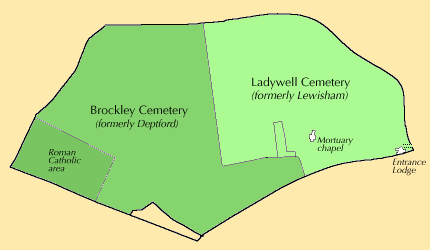
Gertie’s Grave, a short walk from the Chapel in Ladywell Cemetery.          

School caretaker Benjamin Batt sifts through the rubble, where his son Alfred was amongst the dead.


Funeral Procession of the Children along east India Dock Road.

Pupils from North Street School at post-war memorial service 1919.


Memorial of the 18 children in Poplar Recreation Ground.  

School photos with kind permission of Tower Hamlets Local History Library and Archives.

Picture of Gertie, copyright of the Imperial War Museum.

Colour Pictures,  Phill Barnes-Warden.

Compiled by Phill Barnes-Warden,  FoBLC Member


We will be stopping at Gertie’s Grave During the Guided walk of the Open House Event on the 20th September 2020

Guided Walk - Rounding off the Great War - Sunday 15th September 2pm-3.30pm

FOBLC historian Peter Mealing will be leading this guided walk (assisted by Mick Martin and Mike Guilfoyle) bringing together the strands of the First World War reflected in the memorials to some of those who fought and perished in the conflict, military and civilian, in the two Cemeteries as well as looking at its profound aftermath in shaping the modern world.


All welcome - Meet at the Ladywell Cemetery Cross of Sacrifice on Sunday 15th September 2pm-3.30pm


Soldiers celebrating World War I Armistice in November, 1918.
Time Life Pictures/US Army Signal Corps/The LIFE Picture Collection/Getty Images

Death of a Local Hero : Major Charles Edward Fysh DSO MC and Bar. Killed in Action on the Marne, France July 28th 1918


Major Charles Edward Fysh
Major Charles Edward Fysh (1894-1918)
Located alongside one of the inner pathways in Ladywell cemetery lies the headstone (see photograph below) on which the name of Major Charles Edward Fysh is inscribed with those of his parents. He was with British troops taking part in Marshal Foch’s large scale and highly successful counter offensive of the River Marne in July 1918, which proved to be the start of an unbroken series of Allied successes termed 'The Hundred Days Offensive' lasting until the November 11th Armistice.

The headstone will be visited on a Guided Walk: The Final Push on Sunday 9th September 2pm – 3.30pm. The walk commemorates  the final efforts to end the First World War and will visit other relevant headstones and memorials.
Headstone with name of Major Charles Edward Fysh inscribed alongside those of his parents.
It was whilst serving with the 6th battalion Seaforth Highlanders that he was killed on 28 July 1918 at Chaumuzy on the Marne while holding the rank of Acting Lieutenant Colonel. He had attended Colfe's School from 1906-1911 and was 23 when he was killed having earlier joined the Seaforth Highlanders on the outbreak of war from his university Officer Training Corps.  The London Gazette of 24 July 1917 carries the citation for his first Military Cross : “ For conspicuous gallantry and devotion to duty in leading his company in a successful counter-attack upon the enemy. He afterwards personally reconnoitred and cleared up the situation in front of his line, taking command of another company which had lost its commander and establishing strong posts and communication with both flanks. His promptness and initiative were most marked. ”

His second MC was Gazetted on 23 July 1918 :”For conspicuous gallantry and devotion to duty. It was mainly owing to this officer's courage and determination in command of a company that the line held throughout two days' fighting. He continued his fine work during the three following days, constantly exposed to machine-gun fire, and by encouraging his men inflicting heavy losses on the enemy.

The citation for his Distinguished Service Order Gazetted on 13 September 1918 reads : “For conspicuous gallantry and devotion to duty in command of his battalion in action. He displayed great capabilities for organisation, rallying men of other units and leading them forward through heavy fire to posts from which they were able to inflict severe loss on the enemy. He made repeated reconnaissances to the front and flanks, regardless of his own safety, and on one occasion it was mainly due to his good work that the enemy failed to effect a crossing over a canal.”

He is buried in the churchyard of the village of St Imoges near Epernay
(Inline image)  churchyard of the village of St Imoges near Epernay

The Fysh family have a very distinguished lineage - one relative Sir Philip Oakley Fysh became Premier of Tasmania and another was Sir Wilmot Hudson Fysh, KBE, DFC who became a famous Australian aviator during the Great War in the Middle Eastern Campaigns and was the founder of the Australian airline company Qantas
Inline image

Messages, Medals, and Memorials – public art exhibition in Ladywell Cemetery Chapel Saturday 8th & Sunday 9th September 11am – 4pm

Messages, Medals, and Memorials – a public art exhibition which will be in the Chapel of the Ladywell Cemetery on Saturday 8th & Sunday 9th September 11am – 4pm, commemorates the contribution of Colonial troops and the Labour Corps to the war effort in the First World War. Though never fully acknowledged, Europe's Great War was a war of colonials and a colonial theatre of war. Over 4 million African, Indian, Caribbean and other colonial troops and personnel played a crucial role in supporting the Allied cause in World War I. The Labour Corps, formed in January 1917, grew to some 389,900 men, more than 10% of the total size of the Army by the Armistice on 11th November 1918.


In sharp contrast to notions of duty, honour and fighting for King and Country, Colonial troops and Labour corps faced a whole range of inequalities in military and non-military equipment, mobility and privileges that separated them from their white counterparts. Non-white colonial troops and labour corps were routinely segregated, closely watched, subject to curfews and other restrictions.

Messages, Medals, and Memorials through the artworks on display tells the stories of their lives before the war, their war service and their heroism, as well as the memorials that stand as a testament to their sacrifice. Nicky Scott-Francis explores the war service of the Gurkhas. Sara Scott will focus on the Sikh soldiers of the Indian Army who lost at least 174,187 soldiers during the war. Monica Wheeler tells the story of black soldier Walter Tull, whilst Louse Kosinska looks at the contribution of the North and South African Labour Corps. Elizabeta Chojak-Mysko draws attention to the Chinese Labour Corps, the soldiers of ‘menial chores’ who worked 10 hours a day, 6 days a week. Jill Rock and Jolanta Jagiello uncover the truly forgotten ‘soldiers’, Jill Rock commemorating the 210,000 Irishmen who served in the British forces, with Jolanta Jagiello highlighting Conscientious Objectors who refused to kill and were imprisoned for their beliefs fighting in the name of peace.

The exhibition was originally funded by Southwark Council Neighbourhood Fund and is curated by Jolanta Jagiello.  The exhibition is in the Chapel of the Ladywell Cemetery, Ladywell Road, SE13 7HY on Saturday 8th & Sunday 9th September 11am – 4pm.   www.artgoingplaces.com and www.foblc.org.uk.

A Tribute to Second Lieutenant Hugh Gordon Langton- killed at Passchendale October 25th 1917


One of many iconic images of the Passchendaele battlefield in 1917
Passendaele (Passendal) is a small village five miles north-east of Ypres in Belgium and is the name by which the final stages of the Third Battle of Ypres are better known. Along with the Somme, it has come to symbolise the Great War for many. The Third battle of Ypres was preceded by the attack on Messines ridge in June 1917. The main battle commenced on the 31st of July 1917, and stretched on until November the 10th, 1917. The final phase, the advance on Passchendaele, took place in October and November, the aim being to take the strategically important high ground of the Passchendaele ridge. The first battle of Passchendaele, on the 12th October, failed to take the village, and the second battle of Passchendaele lasted from the 26th of October until the 10th of November. After over three months, with 325,000 Allied and 260,000 German casualties the result was little more than to expand the ground covered by the Ypres salient and the controversy over the conduct of the Battle remains to this day.

Second Lieutenant Hugh Gordon Langton, (4th Battalion-London Regiment) Royal Fusiliers

On Sunday, November 5th, 2017 at Poelcapelle CWGC Cemetery near Ypres (Ieper), Belgium (see below), there was a ‘special centennial memorial’ for Second Lieutenant Hugh Gordon Langton, (4th Battalion-London Regiment) Royal Fusiliers, who was killed in action on October 26th, 1917, during the ‘Battle of Passchendale’.  Eight members of the Friends of Brockley & Ladywell Cemeteries group attended as part of a British delegation at the kind invitation of Gil Bossuyt (First World War guide- www.frontaaltours.com). Also in attendance playing the moving music for the tribute were 45 musicians from the local Flemish Deerlijk Brass Band.  The event was recorded by the Commonwealth War Graves Commission (see link below) and in a welcome break in the weather during a sunlit interlude a poppy wreath was laid at the headstone.

Headstone of Second Lieutenant Hugh Gordon Langton -Poelcapelle British cemetery
Hugh Gordon Langton was a very promising violinist, who was taught by the most prominent music teachers from that time from across Europe. The grave of Hugh Gordon Langton is the only one of all Commonwealth graves and memorials (there are more than a million worldwide) which has musical notes inscribed as an epitaph. However a recent tonal revision of the musical notation - the piece was originally thought to have been from ' After the Ball is over' a popular Tin Pan Alley song from 1891, has led to some doubts by music scholars as the notes would suggest a different composition.


As part of the planned visit the Friends group were able to benefit from an excellent guided walk from Gil over parts of the former Battlefield, to be present at the playing of the last post at the Menin gate, Ypres and to enjoy the warm hospitality offered after the Sunday tribute by sharing in a memorable meal with Gil and members of the band in nearby Zonnebeke before returning home.

Members of the Friends group with local tour guide Gil Bossuyt in Poelcappelle cemetery
At @CWGC Poelcapelle British Cemetery in Belgium on Sunday, 45 musicians from the Deerlijk Brass Band performed a special #HoldHighTheTorch tribute during a ceremony commemorating Second Lieutenant Hugh Gordon Langton. Download the free app here

Family grave of Hugh Gordon Langton’s parents and his younger deceased brother in Brockley cemetery.

Frederick Innes OBE (1864-1921): Silvertown Explosion 1917

Silvertown Explosion illustration
Contemporary newspaper illustration of the Silvertown explosion
Close to the Ivy Road pathway in Ladywell cemetery enveloped in its chitinous grassy embrace lies the Innes family grave of Frederick Innes, who died aged 57 years on the 14th December 1921.  Grandfather to FOBLC stalwart Ron Innes,  Frederick was intimately connected to the biggest explosion ever to hit the metropolis which destroyed a large part of Silvertown in East London on the 19th January 1917. The centenary of this tragic even is being commemorated.

Frederick Innes was later awarded the OBE for his  brave and public spirited actions on the day.  He worked as Chief Valvesman at the East Greenwich Gasworks which was damaged by the blast and worked heroically to save the gas supply to South London.  The Greenwich Peninsula History 2013 has the following account:

At 7 p.m. on l9th January l9l7 the Brunner Mond works at Silvertown went up – to the credit of Chief Valvesman Innes and his second Percy in charge of No.2 they managed to switch the supply over to No l. and the gas supply of South London was maintained. The holder’s builders had designed it to withstand hurricanes but the pressure of the munitions explosion ruptured it and 8 million cubic feet of gas extant in Greenwich – Charlie Wellard (whose biography is in Woodlands Local History Library} asked his mother if it was the end of the world. An old lady down the road from me says she saw a red hot girder blown across the river and pierce the gas holder. 

The devastation from the explosion is evident from this photograph  

On 19 January 1917, in the darkest days of the Great War, a massive explosion rocked London’s East End. Shockwaves could be felt in Essex, while the blast itself was heard as far away as Southampton and Norwich. But the firestorm wasn’t caused by the sinister German Zeppelins that were making increasingly frequent appearances on London’s skyline. In fact, the roots of capital’s biggest ever explosion were much closer to home: a TNT factory in Silvertown.

From the outset, the management of the former Brunner, Mond and Co. chemical works had expressed their concern about government plans to turn their plant over from the production of caustic soda to TNT for munitions. TNT is a highly unstable substance and the factory was in a crowded urban area. The Metropolitan Building Act of 1844 made it illegal to carry out ‘harmful trades’ inside the boundaries of London. But Silvertown was just outside this boundary, and its plentiful supply of labour and easy access to ports made it too good a location to overlook. In September 1915, the management caved to government pressure and the plant was soon making nine tons of TNT a day.

Sadly, the management’s concerns were founded. The explosion that ripped through the factory on that fateful Friday evening instantly destroyed part of the factory and several nearby streets. It showered molten metal across several miles, starting wild fires that could be seen as far away as Kent and Surrey.

The whole heavens were lit in awful splendour. A fiery glow seemed 
to have come over the dark and miserable January evening.
The Stratford Express


More than 900 homes near the plant were destroyed or badly damaged in the disaster, leaving thousands of people homeless. Between 60,000 and 70,000 buildings were damaged to some extent, including a gasometer over the river in Greenwich which blew up, spewing 200,000 cubic metres of gas into the air in a massive fireball. Factories, docks and warehouses were also decimated. The eventual repair bill was around £250,000 – a staggering amount of money at the time.

Even more serious was the human cost. Seventy three people died that day. More than 400 were injured, 94 of them seriously. One man lost his wife and four children, aged between 10 and 13. The dead also included many firemen from the local station, along with dock and factory workers and children, asleep in their beds. But the death toll could have been much worse: by a stroke of luck, the explosion happened at just before 7pm, after most people had left the factory for the day and before they had gone to bed (most of the damage to homes was to the upper floors).
Notice from the Mayor of Newham offering emergency assistance to those affected by the Silvertown Explosion 


The precise cause of the explosion has never been found and rumours abounded of sabotage by a German spy or that the factory had been hit by a German bombing raid. The most likely explanation is much more mundane – that fire broke out in a melt-pot room and quickly spread to railway wagons where 50 tons of TNT was waiting to be moved. The inquiry found that the site was totally unsuitable and that Brunner Mond had failed to look after the welfare of its staff. The government chose not to publish the findings until the 1950s.

The Somme Revisited


On Monday 25th April I accompanied three of my FOBLC colleagues Geoffrey Thurley (the Chair), Mick Martin and Peter Mealing (the driver) across the channel, following the route that General De Gaulle once called the 'fatal avenue', the sweep of low lying country in Northern France heading towards the much visited Somme battlefield (the Somme is the name of a French department and river). The weather was unremittingly poor, with a freezing wind and driving rain,  similar to the conditions that delayed the start of the battle whose centenary will be marked on 1st July 2016, which became the bloodiest day in British military history.   We nevertheless managed to cover several of the most iconic battlefield sites that are forever associated with what at the time was seen as the 'Big Push' aimed at bringing the First World War to an end.

Commonwealth War Grave Commission cemeteries lie dotted along roadsides, there are 242 in the Somme department, and provided a poignant reminder of the horrible losses sustained in the battle. We passed first through the village of Gommecourt at the northern extremity of the 22 mile battlefield,  where the 56th (London) Division fought with particular heroism, before stopping outside the village of Serre, at which many of the 'Pals' battalions in the British Expeditionary Force (BEF) recruited from the industrial towns of Northern England suffered terrible losses attacking German positions uphill from a series of copses, and whose sacrifice was captured in the memorable quote 'Two years in the making, Ten minutes in the destroying', Walking in what was once 'no mans land' with the sound of a skylark overhead and viewing the memorial plaques was a hauntingly memorable moment. The verdant landscape that surrounds the bronze Caribou statue at Beaumont Hamel (opened by Earl Haig in 1925), the scene of the Newfoundland battlefield park was perhaps the busiest of the sites we visited with parties of French and Canadians visitors much in evidence.

The monumental Thiepval Memorial to the missing, containing the names of 73,357 soldiers whose bodies were never recovered, is visible from afar and although we were unable to get too close as preparations for the centenary meant that it was part covered in scaffolding, we did ambulate it before moving onto Mametz Wood.

Arriving on a single track road at Mametz Wood was a particularly poignant moment, having earlier successfully campaigned for a maroon plaque to be erected at the birthplace of Poet and Artist David Jones in Arabin Road, Brockley, who as a private in the 38th (Welsh) Division was wounded there following a bloody action to capture the wood, an action launched on the 7th July 1916 and who later recounted his experiences in his masterpiece 'In Parenthesis'. We placed a wooden cross at the foot of the stunning Welsh dragon memorial (erected in 1987) and the photograph at the top of this post was taken shortly thereafter. Alighting for lunch at the much patronised 'Le Tommy ' restaurant in Pozieres- the scene of determined German resistance from the onslaught of Australian troops, due to its strategic importance, we then stopped at the Tank Memorial, three British tanks went into battle for the first time in the history of warfare on the 15th September 1916 before starting on the homeward journey to Calais.

Having arrived safely back in London , due to the commendable forward planning and able direction of our driver Peter Mealing, we were each left with so many powerful memories and recalled in muted conversation some of those remembered in Brockley and Ladywell cemeteries who fell on the Somme, which battle formally ended on the 18th November 1916, the Allies having advanced seven miles for truly enormous losses, before the war then entered another destructive attritional phase.

The friends group have two forthcoming events that will mark the Somme centenary in slightly different ways:   

In the Ladywell cemetery chapel on : Tuesday 31st May at 7.30pm (as part of the Brockley Max festival) Dr Anne Price -Owen ( Director : David Jones Society) will present an Illustrated talk ' David Jones: Artist, Warrior, Author of In Parenthesis’ All welcome.


The Ladywell Chapel, Brockley and Ladywell Cemetery, SE4 (where David Jones is buried) - The evening of July 9th 2016

A performance of our David Jones In Parenthesis programme. This is another very exciting site-specific performance for the Company. Both these performances fall within the exact centenary dates of the Battle of Mametz Wood, which much of In Parenthesis is based on. (This event is subject to final confirmation)

Mike Guilfoyle
Vice-Chair, FOBLC

THE DAY TSAR NICHOLAS II MET BROCKLEY AVIATOR

Russian aviator and inventor Captain Sergei Alexandrovich Oulianine (aka Ulyanin) 1871 -1921

Part hidden off the pathway heading towards the near seamless boundary between Ladywell and Brockley cemeteries, topped by a broken cruciform headstone, lies the final resting place of the distinguished Russian aviator and inventor Captain Sergei Alexandrovich Oulianine (aka Ulyanin) 1871-1921.   He lies buried alongside his wife Ludmilla Oulianine (1887-1970)

Captain Ulyanin was based at the famous Imperial Air force flying school in Gatchina (Petrograd, now St Petersburg).  This was the first aviation school in Russia and as its head he was responsible for the training of a galaxy of outstanding airmen at the outbreak of the Great War in 1914.   His name was almost as legendary as some of his former students who became internationally recognised as fighter aces including the prolific aircraft designer Igor Sikorsky, and Pyotr Nesterov,  the founder of aerobatics, including the famous death loop. 
A Russian Pilot by Vassily Svarog (cover of the Solntse Rossii monthly, ca. 1916)

The first aerial photographs were taken over Paris in 1858 by French photographer and balloonist Gaspard- Félix Tournachon. In Russia, aerial photography was pioneered by Lieutenant Alexander Kovanko and Dimitry Mendeleev the scientist better known for creating the periodic table.  In 1885, they set up a park for training army officers in aeronautics and aerial photography. But in the 1890s, Captain Sergei Ulyanin's noted enthusiasm and technical expertise led to the development of box-shaped kites especially for aerial photography.

Ulyanin’s 19th century “drones” could carry a camera either as it went aloft or be the receptacle for one sent up the string on a small cart once the kite was airborne. Sergei Ulyanin had also invented a type of aerial camera that was built specifically for aircraft and was ideal for military use. The camera had a pneumatic altimeter and a clock that time-coded the 13x13cm images. Indeed Ulyanin type kites had been used as a part of aerial reconnaissance and the mapping of terrain during the disastrous Russo-Japanese War of 1904 -1905.  However it was not automatic and had to be operated manually from the aircraft. Certainly determining the coordinates of enemy forces became an essential aspect of contemporary warfare in light of the stalemate of trench warfare, intense artillery bombardments and the protecting or assaulting of fortified positions.  As the aircraft had to fly at low altitude  around 5,000 feet)and as they were not armoured the risk of being shot down was considerable. The longest siege of the First World War at the Austro-Hungarian fortress of Przemysl (present day Poland) from 1914 -1915 witnessed the extensive use of aerial photography by the Russian Imperial air force. By April 1917 a total of 77 Russian aircraft had been fitted with Ulyanin's camera.

This remarkable photograph shows Captain Ulyanin meeting Tsar Nicholas II,
believed to have been taken on a visit to Gatchina on 26th October 1911. 

It remains a mystery how this remarkable man who as a Russian engineer, balloonist, and military pilot, creator of the collapsible aircraft and the initiator of aerial photography in the Russian military, arrived in London.   Possibly it was as an emigre following the collapse of the Russian Empire in 1917 after the October Revolution and bloody Civil War.  Not far from where families now fly kites on Hillyfields lies the spot in Brockley & Ladywell Cemeteries where Captain Ulyanin lies quietly interred,  inventor the aerial kites which helped the Russian military gain an edge at the outset of the Great War before the use of airplanes became more widespread and whose memory is still held in such considerable esteem for his contribution to aviation history.


Lance Corporal Debenham, killed in action 100 years ago at the Battle of Loos

On the pathway adjacent to Ivy Road in Ladywell cemetery, mournfully cradled by wreaths of ivy, lies the family grave of Lance Corporal Frederick Ernest Debenham -1894-1915 (1/20th London Regiment) killed on the first day of one of the most intense and bloody battles fought by the British Army in 1915 namely the Battle of Loos on September 25th.


The Battle of Loos was part of a joint allied offensive on the Western Front - dubbed the 'Big Push' which began on the 25th September 1915 and engaged 54 French and 13 British divisions, including many of Lord Kitchener's New Army units, on a front of 90 kilometers in Northern France from the small town of Loos in the north to the famed Vimy Ridge in the south. Casualties were simply appalling - 60,000 of whom died on the first day (the names of those killed in the opening fighting filled four pages in the London Times) in an attempt to breakthrough German lines (8,000 yards of enemy trench were captured) but the failure to exploit these gains has been the subject of much subsequent bitterly contested commentary. The battle also marked the first time that the British Army used poison gas as part of its military offensive.
Battle of Loos
Lance Corporal Debenham who worked as an Accounts Clerk before the outbreak of the war lived at the family address on Stanstead Road , Catford. He was killed on September 25th in the intense fighting that characterised the opening days of the battle and his name is remembered on the Old Dunstonian RFC Roll of Honour 1914-1918 
Lance Corporal Frederick Ernest Debenham1/20th London Regiment

An outline of the contribution made by Old Dunstonians RFC who fought in G Company 20th London Regiment at the Battle of Loos notes the following significant information :
When the unit went to France in March 1915 the Old Dunstonian Platoons went with it, and this is the only recorded example of a single unit of Old Boys from one school serving overseas together. The Platoons went through fighting at Festubet and Givenchy with only light casualties, but on 25 September 1915 the unit attacked Loos as partof the 47th (London) Division and were almost destroyed. During the initial attack the Platoons led the attack through Loos village, and had further casualties in the following days of fighting as the Germans counter attacked. Most of the survivors were of officer standard and were commissioned into other units, and by the end of 1915 G Company had lost its unique Old Dunstonian character.

Rudyard Kipling, perhaps best-known for his classic children’s novel The Jungle Book (1894), wrote a haunting elegy to his son, and all those young men like LC Debenham who was aged 21 years when he was killed, who where lost in the great war, Second Lieutenant John Kipling who was killed in action on the 27th September at Loos :

That flesh we had nursed from the first in all cleanness was given…
To be blanched or gay-painted by fumes – to be cindered by fires –
To be senselessly tossed and retossed in stale mutilation
From crater to crater. For this we shall take expiation.
But who shall return us our children?


LC Debenham whose body was never recovered is also remembered on the Loos Memorial
Loos Memorial, France 


Welcome To Hell: The battle for Lone Pine

PRIVATE HAROLD GREENAWAY
 AUSTRALIAN INFANTRY 
KILLED IN ACTION
7th AUGUST 1915 GALLIPOLI

On the pathway heading away from the Ladywell Chapel just before the wall of remembrance (Heroes Corner) lies the family grave of Private Harold John Greenaway who was killed in action on Saturday 7th August during the ill-fated Gallipoli campaign of 1915. Born in Catford in 1893, Harold worked as a storeman before enlisting in Victoria, Australia in August 1914 in the Australian Imperial Force (AIF) serving in Egypt before falling in action during the iconic engagement with Turkish forces at the Battle for Lone Pine which occured on the Gallipoli peninsular between the 6th and 9th August. 

The battle for Lone Pine has gone down in Australian military history as one of the toughest and most brutal ever fought by Australians in any war. A contemporary account captures something of the sheer hellishness of the battle: 'Just after midnight , the Australians launched their attack. It was a slaughter- the Turks were prepared and waiting. Australian dead and wounded covered no-mans-land, while others completely blocked the tunnel openings. Another attack was organised, and just before 4am the men charged again, but the end result was never in doubt and a fresh pile of dead and wounded Australians soon lay scattered in front of the Turkish trenches.'
Welcome To Hell: The battle for Lone Pine
In four days of intense often hand to hand fighting with Australian and Turkish trenches only yards apart. Almost 2,800 Australians became casualties in this battle ( with Turkish losses close to double that number) Of the nine Victoria Crosses awarded to Australians for the Gallipoli campaign, seven were awarded for outstanding acts of bravery over those four days. It is perhaps fitting that each Anzac Day (25th April) is conducted in the Lone Pine Cemetery , which is the largest Australian cemetery on the peninsula

With the centenary of the battle of Lone Pine fast approaching perhaps visitors who light upon the Greenaway family headstone will stay their step and in a silent moment reflect on the sacrifice of one local family whose two sons now lie buried on foreign soil. Private Harold Greenaway lies buried in Shrapnel Valley Cemetery . His brother Charles Frederick (East Kent Regiment-The Buffs) whose name is also remembered on the headstone in Ladywell cemetery was killed the following year in 1916 at Beersheba also fighting against Turkish forces during the Sinai and Palestine campaign.

Harold John Greenaway headstone: courtesy of Billion Graves

A look back at the tragic sinking of the HMS Good Hope

With the hundred year anniversary fast approaching of  one of Britain's worst naval disasters, there is something quite mournful about the leaf covered wording on the side of the Hawkes family grave a few yards from busy Brockley Road. It records the death of Able Seaman Reuben Ernest Hawkes, son of George and Amelia of Woodpecker Road New Cross, who served on the Battle Cruiser HMS Good Hope which was sunk with the loss of all hands at Coronel, off the coast of Chile, on the 1st November 1914.  The British were under the command of Rear Admiral Sir Christopher 'Kit' Cradock who had been tasked with intercepting a German squadron under the legendary Admiral Graf Von Spee which it was feared was likely to wreak havoc against vital supply routes between Britain and South America.

Able Seaman Reuben Ernest Hawkes Brockley Ladywell Cemetery
Grave of Able Seaman Reuben Ernest Hawkes, courtesy of Billion Graves

Cradock had two older cruisers, HMS Good Hope and HMS Monmouth, along with a light cruiser and an auxiliary ship, and was clearly up against a superior German force. The ships Cradock had were obsolete and he was up against a crack German squadron that had more armour and more speed. The battle saw both the Good Hope and Monmouth lost with all hands, while the light cruiser HMS Glasgow escaped by the skin of its teeth. Controversy still surrounds the decision from the Admiralty and its first Lord Winston Churchill that they had to take on this superior German naval force. Cradock had requested reinforcements but was informed that he had enough firepower to be able to handle the situation. He was blamed for this naval disaster but was unable to rescue his reputation as he perished along with 1,660 British sailors in the stormy waters off the South American coast. This engagement appears to have been nothing less than a suicide mission and the fact that he and so many of his naval crew died attests to the incredible courage on display on that fateful day.

After Coronel, at a reception with the German community at Valparaiso, Admiral von Spee was presented a bouquet of flowers for the naval victory. In his thank-you response he stated that it would do nicely for his grave.  

A painting; Battle of the Falkland Islands.

On December 8th 1914 the Royal Navy took revenge at the Battle of the Falkland Islands. Von Spee's flagship, Scharnhorst, together with Gneisenau, Nürnberg and Leipzig were all lost, together with some 2,200 German sailors, including Spee himself and his two sons; his eldest son, Lt. Otto von Spee, who served aboard the Nürnberg, and Lt. Heinrich von Spee who served on the Gneisenau. The admiral went down with his flagship, the Scharnhorst, along with all hands


The BFI are planning to screen a 1927 film recreating the Battles of Coronel and the Falkland Islands

Wrenches, Trenches, and Stenches: a public art exhibition commemorating the start of the First World War

Public Art Exhibition commemorating the start of the First World War


Ladywell Chapel hosted a two day art exhibition commemorating the start of the First World War. on Saturday 2nd & Sunday 3rd August 2014.


The First  World War - or the Great  War 1914-1918 was fought on 3 continents and saw 14 million killed and 34 million wounded. This year commemorates the 100th year anniversary of  the start of the First World War on 5th August 2014.Women war artists were commissioned in the First World  War, but had few opportunities to venture beyond the domestic, social, and industrial operations on the home front.

This public art exhibition commissioned 7 women artists to give their unique perspective on the First World  War from life on the front line, as well as on the home front. Each artist produced 3 artworks: commemorating the start of  the war in 1914; the middle of the war in 1916; and the end of the war on Armistice Day in 1918.

Nicky Scott-Francis looked at the landscape of  war based on research at the Imperial  War Museum - particularly the fear of a gas attack. Jolanta Jagiello based on research f rom the Musei della Grande Guerra Open Air Museum in South Tyrol examined how deliberately setting off avalanches saw thousands of soldiers serving in the Alpine Front killed. Elisabeta Chojak-Mysko’s artworks focussed on the heat of  battle so that we should not forget. Whilst Sara Scott told the personal story of  her grandfather’s munitions factory and its contribution to the war effort. Louise Kosinska traced the love story between her grandfather in Belgium and her grandmother serving as Red Cross Nurse. Monica Wheeler highlighted how families were divided by the war, serving on all sides. And f inally Jill Rock concentrated on her German family roots, interned in Britain for their own safety during the World War I.

The exhibition was curated by Jolanta Jagiello and funded by Southwark Council Community Fund. Guided walks of notable graves were also  led by the Friends of Brockley & Ladywell Cemeteries.

www.foblc.org.uk                                      www.artgoingplaces.com

The WW1 scandal of the sinking of Submarine E13

Following the recent cutting back of overgrowth by Bereavement Services employees in the Ladywell section of the cemetery we were particularly pleased to be able to locate the family grave of Able Seaman Alfred J Payne. 

Able Seaman Alfred J Payne gravestone brockleyy cemetery

The grave lies a few yards from the path that runs alongside the boundary with the Brockley side. In the early hours of August 19 th 1915 the British E -Class Submarine E-13 under the command of Lieutenant Geoffrey Layton RN ran aground on the Danish Island of Salthom (Denmark being a neutral country in WW1). A Danish torpedo boat arrived on the scene, and as was the convention, communicated to the E-13 that she had 24 hours to recover herself and depart, otherwise she would be impounded and the crew interned. When all efforts to refloat her had failed at 09.00 am two German Kriegsmarine Torpedo Boats Destroyers arrived, and after raising a commercial flag, Cmdr Layton had no time to respond before a torpedo was launched and the second boat opened up with all her guns which caused the Submarine to catch fire and the call to abandon ship was issued.  But for the timely intervention of one of the Danish Torpedo boats which moved to place itself between the E-13 and the German warships the casualties would have been much greater. 15 sailors were killed including Able Seaman Payne 4317. Another fifteen Officers and men survived and spent the rest of the war interned, although Cmdr Layton later escaped and made his way back to England.
Drawing of sinking of Submarine E13


The incident resulted in International Outrage , with one leading Swedish Newspaper characterising the act as ' wilful murder' http://trove.nla.gov.au/ndp/del/article/20051888 The London Times headline ran as follows : STRICKEN E 13 SHELLED OUTRAGE IN NEUTRAL WATERS DANISH PROTEST

The story of the E-13 went around the world happening as it did three months after the sinking of the Passenger Liner Lusitania. The German authorities explained that they had violated Danish neutrality due to the fact that British submarines operating in the Baltic Sea had earlier fired on their battleship 'Moltke'.  Three days after the outrage the dead sailors funeral service was held at the St Albans English Church in Copenhagen following a memorial service which representatives of the Danish Navy and Government attended. The steamship Vidar ( ironically sunk in 1940 by a U -Boat) then transported the deceased sailors to Hull where thousands gathered and full naval honours were accorded. A remarkable silent newsreel film records this event http://www.itnsource.com/shotlist//BHC_RTV/1915/09/02/BGT407040765/?s


The Danish Queen Alexandra sent wreaths of lilies for the hearse drawn coffins through the streets of Hull. The CWGC remembers Able Seaman Payne http://www.cwgc.org/find-war-dead.aspx?cpage=1 and for those who might at some point stroll amongst the bosky pathways into this part of the cemetery, might stop to recall for a brief moment the tragedy of the E-13.

For a fuller account of the tragedy readers are invited to visit this link :

FORGOTTEN BATTLEFRONTS OF WORLD WAR ONE

With the centenary of the outbreak of the Great War later this year, the FOBLC will be undertaking a 'curtain raiser'  guided walk to the family graves of some of the soldiers and seamen who gave their lives for King and Country in some of the lesser known war zones of World War 1.
Men of the 1/5th Battalion of the Buffs (East Kent Regiment) passing over the Jebel Hamrin ( Palestine), December 1917.
Men of the 1/5th Battalion of the Buffs (East Kent Regiment) passing over the Jebel Hamrin ( Palestine), December 1917. .

We will be stopping and reflecting during the walk on the following battlefronts - Italy, Salonika( Greece) East Africa, Denmark, Mesopotamia, Egypt and Palestine. 
 
 
The walk will start from the Ladywell Entrance at 2pm on Sunday 16th February and last approximately 90 minutes.  It will be led by the FOBLC's Mike Guilfoyle, Peter Mealing and Mick Martin and it is free.

Francis Paget Hewkley: awarded Military Medal for bravery at the Somme

Many thanks to Stuart Hallifax who has written a great piece on Francis Paget Hewkley in his Great War London blog.  Hewkley was brought up in London, emigrated to Australia in 1912 and then enlisted a signalman in the Australian infantry.  He served at Gallipoli before transferring to the Western Front where he won a Military Medal for his bravery in the Battle of the Somme.
One of Hewkley’s drawings for the ANZAC Book

However in June 1917 Hewkley was killed in action at Zonnebeke Ridge.  He was buried in a nearby Belgian military cemetery but is commemorated on his parent's headstone in the Brockley & Ladywell Cemetery. 

For the full article please click here


Frances Paget Hewkley Family Grave
Frances Paget Hewkley Family Grave: source Billion Graves

British Lion and Great War hero

The somewhat run down family grave of Forest Hill Wine Merchant Bruce Beveridge Todd and his wife Phoebe lies next to the Dissenter's Chapel in the Ladywell section of the cemetery. However that of their son Alexander Findlater Todd born 20 th September 1873 , known as 'Fin' to his friends, is sadly missing from any inscription. To see his final resting place you will need to travel to Poperinghe War Cemetery, Leper, Belgium ( known as 'Pops' to British tommies) http://www.webmatters.net/txtpat/?id=507


Todd family grave: Alexander Findlater Todd
Todd Family grave


Alexander Findlater Todd (20 September 1873 – 21 April 1915)  was an English rugby union  forward who played for Cambridge University and Blackheath FC at club level, and Kent at county level. Todd played international rugby for England and later represented the British Isles team on their tour of South Africa.  Todd was an all-round sportsman, captaining his school team in football and playing cricket for Berkshire in 23 matches between 1910 and 1913.  The Wisden obituaries of 1915 refer to Todd as a '...capital wicket keeper'.
Alexander Findlater Todd (20 September 1873 – 21 April 1915)

Todd was born in Lewisham in 1873 to Bruce Beveridge Todd, a wine merchant from Forest Hill, and Phoebe Brooker. He was educated at Mill Hill School before matriculating to Caius College in 1892. He received his BA in 1892, and after leaving university he joined the British Army, and saw action in the Second Boer War with both Roberts' Horse and Carrington's Horse.  He rose to the rank of squadron leader during the campaign and was wounded in action. On his return to Britain he set up in business in London, and on 2 December 1902 he married Alice Mary Crean, sister of Thomas Joseph Crean VC with whom Todd toured South Africa in 1896.

In 1914 he joined the special Reserve Battalion of the Norfolk Regiment and reached the rank of captain whilst serving in France during the First World War. In 1915, Todd was part of the British assault on Hill 60 at Ypres Salient and was shot in the neck, as he peered over a trench parapet. His fellow soldiers had been worried that Todd’s height would expose him to snipers “He seemed perfectly regardless of his danger,” recalled a comrade, Private Coleman, “and two or three men remarked that if he stayed there he was bound to be hit, and suddenly they saw him fall.”  Todd died of wounds in a casualty clearing station four days later.  He was 41 years old and his remains are buried at Poperinge Old Military Cemetery.

Todd was a keen sportsman from a young age, and while at school at Mill Hill he captained both the football and rugby team. On entering Cambridge, he continued his passion for sport and was selected for theCambridge University team. He played in three University Varsity matches, collecting his sporting 'Blues' between 1893 and 1895. On leaving University he joined Blackheath, and would later becoming a leading member of the Kent county team, and was invited to join the touring Barbarian team in 1894. 
Todd is back row, second from right


Six foot two inches tall, Todd played for Blackheath FC and was invited to join the 1896 British Isles (before they were the Lions) tour of South Africa. Aged 23, he drew admiring comments from both the rugby writers of South Africa and from the ladies.  Todd played in all four Tests against South Africa which ended in three wins for the tourists, and a loss in the final game played at Cape Town. In the Second Test, which the British team won by the largest margin, all three tries came from forward positions, one of them was scored by Todd; his first and only international points.

For a more detailed and rounded life story for this remarkable sportsman and soldier the following is  recommended - The Final Whistle: the Great War in Fifteen Players’ by Stephen Cooper (The History Press)